TABLE OF CONTENTS
Why Wage Stagnation Won't Fix Itself — Left and Right Agree
Where prominent a left and right economist agree on wage stagnation
This is part of a series about Innovation Policy
Why Wage Stagnation Happens — And Where Left and Right Agree
Russ Roberts leans right. Daron Acemoglu leans left and holds a Nobel Prize. They argued for hours across two EconTalk conversations — one on good jobs and shared prosperity (2019) and one on technology and power (2023) — and still found more common ground than most people expect. Here is what they both agreed on about wage stagnation, and why it matters.
Wage Stagnation and the Workers Nobody Talks About
For the past 40 years, the U.S. economy has kept growing — but the people who build things, stock shelves, and run machines have been largely left out. Workers without college degrees used to be able to support a family, own a home, and feel like they were part of something.
That pathway has largely closed. GDP went up. Wage stagnation set in. Their share of the national income has been falling since roughly 1980 and has never recovered.
What makes this conversation unusual is who is agreeing.
Roberts is a free-market economist who spent much of both discussions pushing back on government intervention. Acemoglu is a Nobel Prize-winning economist at MIT who believes institutions and policy shape outcomes as much as markets do. These two don't agree on much, which makes the places they do agree worth paying close attention to.
This isn't just a U.S. story. Wage stagnation alongside economic growth shows up across developed economies: in the UK after deindustrialization, in parts of Germany before labor reforms, and increasingly in countries facing rapid automation. The specific workers change, but the structural failure is the same.
Growth happens, but the people doing the actual work don't share in it.
There’s a cost to not fixing this. When large groups of people feel economically abandoned and politically invisible for long enough, they stop believing the system is fixable. That turns wage stagnation into democratic dysfunction — a problem that is much harder to reverse than slow paychecks alone.
(One clarification worth making upfront: Roberts disputes whether the wage data fully captures what happened. He points to possible measurement issues as reasons to be cautious about the numbers. But both speakers agree on what they see in the real world: the workers who used to build a middle-class life, what Russ described as ‘the bottom half,’ largely can't do that anymore. They disagree on the thermometer, not on whether the patient has a fever.)
The Real Consequences of Wage Stagnation Go Beyond the Paycheck
Both speakers agreed on something that gets missed in most economic debates: losing a good job isn't mainly about losing money. Work gives people a schedule, a role, a community, and a reason to get up, so when that disappears and nothing replaces it, people don't just struggle financially — they struggle to explain who they are.
Roberts focused on this dimension more than wages. For him, the loss of meaning, identity, and community is the core of what makes a bad economy bad, not the paycheck alone. Acemoglu agreed completely, adding that this is exactly what political and intellectual elites missed for decades. The people in heartland America who felt invisible were angry less about their wages than about feeling like nobody in power seemed to notice them at all.
This is a well-documented pattern called status loss, meaning the experience of falling not just in income but in social standing and perceived respect. Research shows it's more predictive of depression, family breakdown, and civic disengagement than income loss alone, and more politically explosive too, because status loss feels like something that was done to you rather than something that just happened.
This was one of their single strongest points of agreement across both conversations. Roberts called it explicitly and Acemoglu confirmed it without hesitation.
Felt neglect becomes political rage
When people feel unseen and disrespected for long enough, they stop trying to fix the system and start trying to burn it down. Every normal channel, including voting, organizing, and petitioning, had produced no visible response for three decades, so the anger that reshaped politics over the last two decades tracks almost exactly with the geography of deindustrialization: the places where good jobs disappeared and nothing replaced them.
Both speakers named this pattern directly. Working-class voters had been sending the same signal for 30 years while nobody in power responded, and eventually the signal stopped being a request and became a warning.
Research on political psychology, including work by Jonathan Haidt, adds an important layer here. Working-class voters are responding to feeling morally dismissed as much as economically squeezed, since their values around loyalty, community, and respect get treated as embarrassing rather than legitimate, and policy responses that speak only to wages while ignoring that deeper resentment tend to miss the point entirely.
This broader breakdown is what researchers call institutional delegitimization, meaning when people lose faith not just in specific leaders but in the entire system's ability to respond to their needs. Trust in institutions takes decades to develop and can collapse in a single election cycle, making it very difficult to rebuild once it's gone.
Polarization locks in the problem
The political fallout from that neglect has created a second, separate crisis: a political system that is now less competitive, more internally controlled, and less responsive to what ordinary voters actually want. Both speakers pointed to data showing that congressional voting by party has completely diverged since the 1950s and 60s, where lawmakers used to overlap on many issues and now almost never do.
This matters because the fixes to the underlying wage stagnation problem, including changing the tax code, redesigning education, and redirecting technology investment, all require a political system capable of making hard, long-term decisions. A gridlocked system responds only to the next outrage cycle, so the economic failure produces a political failure that then makes the economic failure harder to fix, and the two keep feeding each other.
Big Tech is making all of this harder to solve
The platforms that most people use to understand politics are designed to keep people engaged, and the content that keeps people engaged longest is content that makes them angry or afraid. This means the platforms are actively profiting from the polarization described above, even if they didn't create the underlying economic frustration.
At the same time, the largest tech companies have accumulated enough political influence to shape the very policy conversations that might otherwise address wage stagnation. They fund research, hire former regulators, and operate at a scale that makes traditional approaches look inadequate. Both speakers agreed that these companies represent a new kind of concentrated power that existing institutions are not equipped to handle.
This was also one of their sharpest disagreements, since Acemoglu saw platform power as a systemic threat while Roberts was more skeptical that market competition would eventually do the correcting. They agreed more on the diagnosis than the cure.
History shows similar patterns with railroads in the 1880s and broadcast media in the 20th century, both of which eventually required new regulatory frameworks. The current moment is earlier in that cycle and moving faster.
Common Approaches to Wage Stagnation That Keep Falling Short
The three most common responses to wage stagnation are redistribution (tax the winners, transfer to the losers), job training programs (teach displaced workers new skills), and market faith (trust technology and competition to eventually sort it out).
Each has real evidence behind it. Each also has a core failure that limits what it can actually solve.
Redistribution treats the symptom, not the source
Giving people money without giving them work addresses the financial gap but ignores everything else — the loss of structure, purpose, community, and status that comes from having a real job. Both speakers agreed: most people do not thrive when their main role is to receive support. They struggle. And over time, the political will to sustain those transfers erodes, because the people writing the checks eventually find ways to stop.
This is what systems thinkers call symptomatic relief — solving for the visible output while leaving the underlying system unchanged. Food banks help hungry people today. They don't address why food insecurity exists. Transfer payments work the same way. They manage the problem without changing the conditions that produce it.
(Of all the places these two economists found common ground, this one was the most unexpected. Both a free-market economist and a Nobel Prize winner both calling redistribution-as-primary-solution a dead end.)
Job training can't solve a structural mismatch
The K-12 system in the U.S. is almost entirely built around one destination: a four-year college degree. Students who won't take that path get the same curriculum anyway, minus the outcome. No one is seriously asking what a student who enters the workforce without a degree actually needs to build a stable life. The curriculum hasn't caught up. The credentials don't exist. The pathways aren't there.
Germany's vocational system is the most-cited counterexample: students choose technical tracks early, earn real credentials, and enter the workforce with direct employer connections. The result is a much smaller gap between what schools produce and what the economy needs from ordinary workers. The U.S. has largely dismissed this model — and wage stagnation among non-college workers has been one of the results.
Market faith ignores what changed after 1980
The standard defense of technology-driven disruption is that it has always created more jobs than it destroyed — and historically, that's mostly true. The problem is that the mechanism that made it true stopped working. Before 1980, automation and new job creation moved roughly in balance. After 1980, automation accelerated and new task creation slowed sharply. The balance broke — and it hasn't come back.
Underneath this is a policy-created distortion: the tax code charges companies roughly 25% on labor costs but only around 5% on equipment and machinery. That gap makes it rational to replace workers even when doing so doesn't actually improve productivity. This isn't a natural market outcome. It's a structural incentive baked into the rules — and it quietly pushes innovation in one direction: fewer people, more machines.
(Both speakers named 1980 as the inflection point where the old balance stopped working — one of the few empirical claims neither challenged.)
What a Real Fix for Wage Stagnation Actually Looks Like
Most responses to wage stagnation either try to compensate workers for losses after the fact or try to retrain them for a different economy. Both are reactive.
The approach that emerges from this analysis is different because it targets the conditions that determine whether economic growth produces good jobs in the first place — rather than cleaning up after it doesn't.
The key insight — and the one both a free-market economist and a Nobel Prize winner landed on — is that technology is not the problem. The problem is which kind of technology gets built, and why. When the rules reward replacing workers over finding new roles for them, that's what companies do. When political institutions are too broken to change those rules, the cycle locks in. The fix has to work at the level of incentives and institutions — not just outcomes.
This is the difference between fixing a leaky roof and mopping the floor. Both address water damage. Only one stops more from coming.
Step 1: Actively create new roles for human work
The historical periods when technology actually raised wages for ordinary workers all shared one feature: new industries and new job categories appeared fast enough to absorb the workers that automation displaced. That didn't happen automatically. It happened because investment and entrepreneurial energy were pointed in that direction.
Today, AI and automation investment is overwhelmingly concentrated in replacing human labor. A deliberate redirect — toward technology that works with people (creating new markets, generating more demand) rather than instead of them — is the actual lever that changes the balance.
Economies don't just produce technology at random. They produce what they reward. Governments and markets can both shape the direction of innovation, not just the volume of it.
(Note: Roberts was somewhat skeptical that governments can effectively steer technology and innovation).
Step 2: Rebuild what getting ready for work actually means
After this, you need workers who can fill new jobs these technologies create — and a school system that actually prepares non-college students for what those jobs require.
That means asking a question nobody is currently asking at scale: what skills, credentials, and pathways does a student who won't finish a four-year degree actually need? This step has to happen in parallel with everything else, or new job creation has no one to absorb.
This is workforce pipeline alignment — designing educational systems around actual labor market demand rather than inherited assumptions about who deserves what kind of education.
Step 3: Fix the tax distortion
This lever is the one that's least visible: the tax gap between labor and capital equipment. As long as it's five times cheaper to buy a machine than to hire a person, that's what rational companies will do, even when it doesn't make economic sense beyond the tax benefit.
This doesn't require picking winners or designing specific industries. It just removes a thumb on the scale that currently points in one direction.
This is what economists call price signal correction — changing underlying incentives so that market actors make different choices without being forced to. Carbon taxes work the same way. So does removing subsidies from industries you don't want to favor.
(Roberts acknowledged the tax distortion is real. His concern is not whether it exists but whether government intervention to correct it would introduce new distortions of its own.)
Step 4: Restore the political accountability loop
None of the above steps are technically complicated. They are politically blocked.
The two-party system has become less responsive to the median voter and more controlled by organized interests — including tech platforms that profit from the current imbalance and shape the information environment in ways that amplify outrage. Big Tech's ability to concentrate political influence while simultaneously making polarization worse is not a side issue. It is part of why Steps 1 through 3 remain unaddressed.
Every major historical correction to wage stagnation — the New Deal, the Nordic model, postwar Germany — was preceded by a shift in political power that made reform possible. The political fix isn't separate from the economic fix.
The Outcome When Wage Stagnation Gets Addressed at the Root
When these four steps work together, the result is a labor market where ordinary work, the kind that doesn't require a graduate degree, once again comes with enough income, security, and status to build a life around. Both speakers kept returning to the same basic vision: a floor of dignity where a person who shows up, does the job, and goes home can afford rent, support a family, and feel like a legitimate part of the economy.
That conclusion came from both ends of the political spectrum, which is what makes it worth taking seriously. A free-market economist who distrusts government programs and a Nobel Prize winner who believes markets need active stewardship both looked at the same evidence and landed in the same place: wage stagnation is a policy outcome, shaped by specific choices about taxes, technology, and institutions, and the conditions that once produced shared prosperity can be rebuilt through equally specific choices made differently.
The past shows it's possible. Whether the present political system is capable of making those choices is uncertain.
Frequently Asked Questions About Wage Stagnation
What is wage stagnation and why does it happen?
Wage stagnation is when workers' pay stops keeping up with economic growth or inflation over a long period of time. It has multiple causes — automation replacing tasks workers used to do, globalization moving work overseas, tax policies that favor machines over people, and political systems too gridlocked to respond. It's been a defining feature of the U.S. economy since roughly 1980.
What did two rival economists actually agree on about wage stagnation — and where did the surprising overlap land?
More than you'd expect. Their strongest shared view was that work is central to human dignity and meaning — not just income — and that a world where people live off government transfers instead of working would be psychologically devastating for most people, not just economically fragile. Nearly as strong was their agreement that technology does not automatically produce shared prosperity, and that the post-1980 breakdown in the balance between automation and new job creation is real and has not corrected itself. They also agreed that low-skilled workers have been genuinely left behind regardless of what the GDP numbers show, that automation and globalization are essentially the same structural force operating through different channels, and that the felt loss of dignity — not just wages — is what has driven political resentment over the last two decades. Further down the list, both agreed that education reform is critically neglected, that the tax code distorts innovation toward automation in ways that aren't natural or inevitable, that political polarization has broken the system's ability to respond, and that Big Tech represents a new kind of concentrated power that existing institutions aren't built to handle.
Where did Roberts and Acemoglu disagree most on the causes of wage stagnation?
Their sharpest disagreement was over whether trade unions actually raise wages — Roberts argued four decades of falling unionization alongside rising living standards makes it hard to credit unions with much, while Acemoglu pointed to Scandinavian data showing measurable wage compression when unions and employers work together. Close behind that, they split on whether government can effectively steer technology and innovation — Roberts said there's no guarantee government gets it right either, while Acemoglu trusted the democratic process (not technocrats) to create useful guardrails over time. They also disagreed on whether measurements of wage stagnation, given measurement problems with inflation and compensation data; whether large employers actually have power over workers beyond extreme cases like company towns; and whether the U.S. political system is capable of the kind of self-correction that made Nordic economies work. Their smallest disagreements — where they were closest but still not fully aligned — were on whether redistribution plays any legitimate supplementary role, and whether the Industrial Revolution actually harmed workers for 90 straight years or whether workers' voluntary migration to cities tells a more complicated story.
Is wage stagnation the same as income inequality?
They're related but different. Wage stagnation is specifically about pay not growing. Income inequality is about the gap between the highest and lowest earners widening. You can have both at the same time — which is largely what's happened in the U.S. since 1980. GDP grew, top incomes grew significantly, but median and lower wages largely didn't.
How does automation cause wage stagnation?
When automation replaces tasks that workers used to do — without creating new tasks that need human input — the labor share of economic output falls. Workers become less essential to producing each dollar of output, which weakens their bargaining position and keeps wages flat even as the overall economy grows. This is different from older forms of automation, which tended to create new job categories at roughly the same pace they eliminated old ones.
Do some researchers go further than Roberts and Acemoglu on wage stagnation — arguing for universal benefits like healthcare or free education?
Some build on the wage stagnation problem both speakers identified and argue that universal programs — available to everyone, not just the poor — avoid the stigma of traditional welfare and build the kind of cross-class solidarity that makes reform politically durable. Sociologist Gøsta Esping-Andersen points directly to the Nordic countries as proof: by funding universal healthcare, childcare, and pensions through broad taxation, those societies severed the link between a person's market wage and their basic human dignity — achieving levels of social mobility and institutional trust that the U.S. has not matched. This is a direct challenge to how both Roberts and Acemoglu framed redistribution in these conversations — both focused on fixing the labor market as the primary lever against wage stagnation, treating transfers as a symptom-treater at best, while the Nordic evidence suggests that well-designed universal systems can be a structural fix in their own right, not just a Band-Aid.
Can giving workers more ownership actually solve wage stagnation — or is that wishful thinking?
Roberts and Acemoglu didn't discuss this directly, but other economists have built on the same wage stagnation problem they identified and pointed to a different set of tools. The core idea is that wage stagnation is partly a power problem — when workers have no stake in how a company performs, all the gains from productivity flow to shareholders and executives instead. Several models push back on that directly. Employee stock ownership plans (ESOPs) give workers an equity stake in the company they work for, and studies consistently show those workers build more wealth and earn more stable incomes over time. Worker cooperatives go further, giving employees actual voting rights over major decisions — pay, investment, and direction. Profit-sharing programs don't change ownership but distribute a portion of company gains directly to workers. Codetermination — the German model where workers hold seats on corporate boards — gives labor a formal voice in how companies are run before decisions get made, not after. None of these are silver bullets, and worker-owned firms sometimes trade higher wages for greater job security rather than delivering both. But taken together, they represent a set of tools that address wage stagnation at the source — not by redistributing after the fact, but by changing who has a claim on growth while it's being created.
When political gridlock blocks wage stagnation fixes, can public-private partnerships fill the gap?
This idea goes beyond what Roberts and Acemoglu discussed directly, but it connects naturally to the implementation barrier both of them named. Their shared view was that the political system is too gridlocked to deliver the changes wage stagnation requires, and public-private-nonprofit partnerships are one of the more practical ways that workforce and education reforms have historically moved forward outside of partisan budget cycles. Employers partnering with community colleges to build credential programs, philanthropic foundations funding vocational pathways, and local governments working with industry groups to redesign job pipelines have all produced real results in places where federal legislation stalled. The German apprenticeship model that both speakers praised is itself a public-private structure rather than a purely government-run program. The honest limitation is that these partnerships tend to work at a local or sectoral scale, and the wage stagnation problem is national in scope, so they're better understood as a complement to systemic reform than a replacement for it.
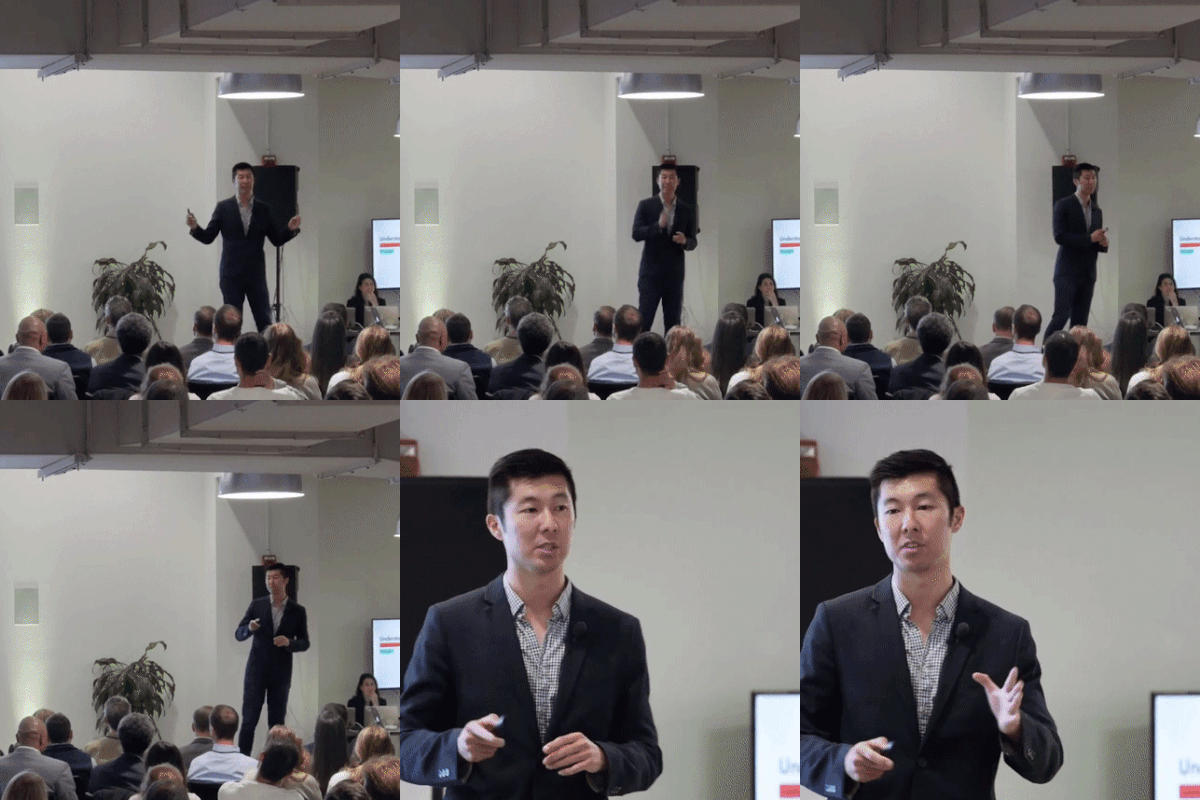
Dan Wu, JD/PhD
Lead Innovation Advisor
I build and advise mission-driven ventures to scale like startups.
SVP of Product & Chief Strategy Officer.
- As a go-to-market-focused product leader, I’ve led and launched products and teams at tech startups in highly-regulated domains, ranging from 6 to 8 figures in revenue.
- Led core products and product marketing key to pre-seed to D raises across highly-regulated industries such as data/AI governance, real estate, & fintech; rebuilt buyer journeys to triple conversion rates; Won Toyota’s national startup competition.
Harvard JD/PhD focused on responsible innovation for basic needs.
- Focus on cross-sector social capital formation, with a strong background in mixed-methods research.
- Selected as a National Science Foundation fellow & published on responsible strategy and innovation in outlets like Oxford University Press, Fast Company, and TechCrunch.
First-generation college student prioritizing inclusion and belonging in his practice.
- I was raised by a single mother without a high school degree.
- I’m passionate about mentoring and coaching using methods that “works with” (versus “do to”), sensitive to one’s constraints and experiences.
 Made with Bullet