Getting Your First Customers in Five Hours a Week

Master a focused strategy for getting your first customers in five hours a week without wasting time on custom proposals or generic networking.
Apr 15, 2026
This is part of a series about Innovation Strategy

✍️
Innovation Insights DB Post List
List view

 
notion image

Getting Your First Customers: 3 Steps to High Paying Contracts

Landing a high paying contract often feels like a full time job you never wanted. You only have five hours a week to spare and every wasted minute at a general networking event threatens your primary career goals. If you fail to learn a focused strategy for getting your first customers you will burn out writing custom proposals for bad leads. But if you succeed you turn your limited hours into a highly profitable revenue engine.
 

Key takeaways

A successful strategy requires targeting specific events where buyers already display high purchase intent. You must package your technical skills into clear operational niches and frame your service as a core utility. You protect your time by diagnosing technical bottlenecks before you ever write a proposal.
 

The 3 Core Drivers of Failure When Getting Your First Customers

Low Intent Prospecting

This driver involves attending broad startup networking events where attendees are looking for funding rather than technical implementation. Spending your limited time in the wrong room means you pitch your services to people who physically cannot afford to hire you.

Offer Ambiguity

This driver centers on having a vague service category that forces the buyer to guess what you actually do. Without a clear operational niche and a specific problem framing you end up proposing complex projects that the market views as optional rather than essential.

Early Proposal Writing

This driver is the destructive habit of drafting labor intensive project scopes before confirming a technical fit. Writing custom documents for unqualified leads is the fastest way to exhaust your bandwidth and lose focus on your core business goals.
 
🪴

A Note From the Author (Dan Wu, JD/PhD)

  • As a former startup SVP of Product, I've lived the challenges this covers. I've used similar frameworks and tools to build and manage responsible, high-growth products generating 6-7 figures of annual revenue.
  • I help social impact leaders find who will buy, what to say, and what to sell, fusing Silicon Valley product thinking & Harvard PhD insight.
 

A 3 Step Roadmap for Getting Your First Customers

This roadmap unfolds in sequential steps starting with finding high intent buyers moving to clear offer packaging and ending with aggressive lead qualification.

1) Target High Intent Events for Getting Your First Customers

What This Is

This step involves identifying local workshops or specific networking opportunities where the audience is actively paying to learn about your technology. You bypass broad pitch events to find business owners who already possess high problem awareness.

Why It Matters

This addresses the Low Intent Prospecting driver. When you only have five hours a week you cannot play the volume game. You must find rooms where purchase intent is already established before you even start a conversation.

How You Can Use It

You will use the High Intent Event Filter to audit local meetups. You search for terms like teach business owners artificial intelligence or marketing automation workshop and ignore any event that mentions general startup networking.

Examples (Toggle for more)
  • Less Productive Example
    • Sarah spends three hours at an open startup pitch night in her city. She talks to four idea stage founders who are all looking for venture capital but none of them have a functioning web application or a budget to hire a technical consultant.
  • More Productive Example
    • Sarah uses the High Intent Event Filter to find a local workshop titled implementing artificial intelligence for small business owners.
    • She identifies that the attendees have already paid fifty dollars to be there which proves they have a budget and high problem awareness.
    • She skips the general networking table and focuses her energy on the three business owners who asked specific technical questions during the presentation.
    • Decision and Output: Sarah chooses to enter a room with pre qualified buyers which allows her to book two discovery calls in sixty minutes instead of wasting her entire week hunting for warm introductions.

2) Package a Niche Offer for Getting Your First Customers

What This Is

This step involves conducting a competitor analysis to define a clear service category. You audit top performing freelancer profiles to understand their specific offering category and exactly how they frame the problem and the solution.

Why It Matters

This addresses the Offer Ambiguity driver. Clients buy solutions to specific bottlenecks like lead generation. If you sell vague technical help without framing the exact operational problem you force the client to do the mental work of figuring out how you fit into their business.

How You Can Use It

You will use the Niche Service Blueprint to package your technical skills. You audit top earning profiles and mirror their language to ensure your offer is positioned as a must have utility rather than a luxury.

Examples (Toggle for more)
  • Less Productive Example
    • Sarah tells a potential client that she can do general user research and software consulting. She completely fails to frame the specific problem the client is facing which leaves the client confused about how her work actually helps their bottom line.
  • More Productive Example
    • Sarah applies the Niche Service Blueprint by analyzing the top technical consultants on a major freelance platform.
    • She first identifies their offering category by noticing that marketing operations is a high demand niche.
    • She then studies how they frame the problem and solution realizing they sell automated customer matching algorithms to fix slow sales pipelines.
    • Decision and Output: Sarah decides to ignore her generalist background and mirrors their exact problem framing which presents her as a specialist and leads the client to ask for her pricing immediately.

3) Qualify Leads Early When Getting Your First Customers

What This Is

This step involves using a structured conversational framework to diagnose operational pain before you ever discuss a budget or write a statement of work. You treat the first call as a mini consultation to find the limiting step of the client.

Why It Matters

This addresses the Early Proposal Writing driver. By gating your project proposals behind a strict validation phase you ensure that you only spend time writing documents for clients who are technically ready to implement your work.

How You Can Use It

You will use the Stage Gate Qualification Script to structure your initial discovery calls. You ask specific questions about their current technical infrastructure and disqualify any client who does not have the foundation required for your service.

Examples (Toggle for more)
  • Less Productive Example
    • Sarah spends four hours writing a detailed five page statement of work for a founder she met at a coffee shop. Two days later the founder reveals they do not even have a live product yet and cannot use the code Sarah offered to write.
  • More Productive Example
    • Sarah uses the Stage Gate Qualification Script during her first ten minute phone call with a new lead.
    • She asks the founder if they currently have an existing database of users and a platform where an automated agent can be deployed.
    • She identifies that the client is not technically ready and decides to withhold her proposal until they hit their next development milestone.
    • Decision and Output: Sarah prioritizes her five hour weekly limit and only writes one proposal for a high probability lead resulting in a signed contract within forty eight hours.

Actionable Checklist for Getting Your First Customers


Checklist (Toggle for more)
  • Search for workshops that teach your specific technology to business owners using the High Intent Event Filter.
  • Review top earning profiles to finalize your Niche Service Blueprint by studying their categories and problem framing.
  • Position your service as a revenue generating marketing operations tool instead of generic consulting.
  • Use the Stage Gate Qualification Script to ask about technical infrastructure in the first five minutes of a call.
  • Only write a proposal after confirming the core operational bottleneck of the client matches your niche.
Toolkit (Toggle for more)
  • High Intent Micro Funnel
    • A high level diagnostic framework to help technical experts land contracts using a low time investment sales process.
  • High Intent Event Filter
    • A checklist used to identify specific networking opportunities where buyers possess high problem awareness and a budget.
  • Niche Service Blueprint
    • A template for packaging broad technical skills into highly recognized categories by mirroring the problem and solution framing of top earners.
  • Stage Gate Qualification Script
    • A structured discovery script used to disqualify low intent leads before you spend time writing proposals.

For more content like this, subscribe below 👇


Getting Your First Customers FAQs

How do I find high paying opportunities when getting your first customers?

You must ignore broad networking and focus exclusively on specific events where business owners pay to learn about technology as these audiences have the highest purchase intent.

How do I stop wasting time on proposals when getting your first customers?

You must implement a qualification process where you only write a statement of work after the client has proven they have the technical infrastructure to support your service.

What is the best niche strategy for getting your first customers in the tech space?

Marketing operations and sales automation are currently the highest performing niches because they represent a direct link to the revenue and efficiency of your client.

How do I balance a full time job while getting your first customers?

You protect your bandwidth by treating your outreach as a highly filtered funnel rather than a volume game. You only spend time on high probability leads that fit your specialized niche.

Why is attending startup events a bad strategy for getting your first customers?

Many startup events are filled with idea stage founders who are looking for venture capital rather than technical execution. They usually lack the budget to hire a specialized expert.


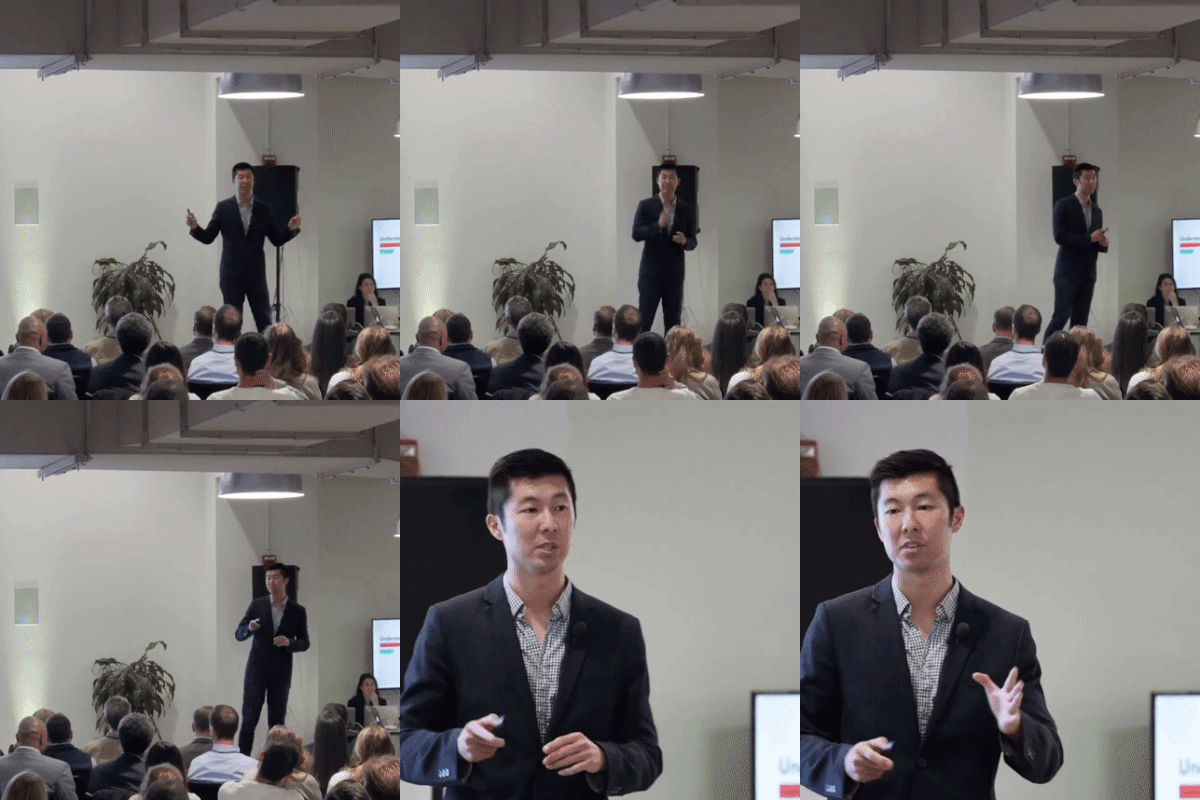
Speaking on responsible innovation

Dan Wu, JD/PhD
Lead Innovation Advisor

I build and advise mission-driven ventures to scale like startups.
SVP of Product & Chief Strategy Officer.
  • As a go-to-market-focused product leader, I’ve led and launched products and teams at tech startups in highly-regulated domains, ranging from 6 to 8 figures in revenue.
  • Led core products and product marketing key to pre-seed to D raises across highly-regulated industries such as data/AI governance, real estate, & fintech; rebuilt buyer journeys to triple conversion rates; Won Toyota’s national startup competition.
Harvard JD/PhD focused on responsible innovation for basic needs.
  • Focus on cross-sector social capital formation, with a strong background in mixed-methods research.
First-generation college student prioritizing inclusion and belonging in his practice.
  • I was raised by a single mother without a high school degree.
  • I’m passionate about mentoring and coaching using methods that “works with” (versus “do to”), sensitive to one’s constraints and experiences.