3 Powerful Strategy Lessons from The Lord of the Rings
Facing an impossible challenge is exhausting.
You might be a startup staring down a giant competitor or tackling a personal goal that feels overwhelming. You have a great team but keep hitting walls and wasting resources.
This guide uses Middle-earth as a case study to provide powerful strategy lessons from The Lord of the Rings, giving you a clear framework to turn your biggest challenges into your greatest victories.
Key Takeaways: A Quick Guide
Leave No Easy Path Open
Your People Are Not Interchangeable
Change the Game You Play
While my analysis usually comes from my work with clients, I’ve found that powerful strategy lessons can come from anywhere, including the epic battles of Middle-earth.
Why Good Teams Lose in The Lord of the Rings
Before learning how to win, we must understand why even the strongest teams fail.
The heroes in The Lord of the Rings made three critical mistakes that are shockingly common in business and life.
Flawed Foundations
The root cause of many failures lies in systems that were built horribly from the start.
At Helm’s Deep, a small drainage grate gave the enemy a way in. Your project might have a similar weak spot -- maybe in your code, your cash flow, or an assumption that doesn’t hold up.
Misaligned Talent
The strategy was often foolish because the right people weren't used for the right jobs.
For instance, at Amon Hen, the team did not use their strengths to spot the Uruk-hai before they reached to camp or protect their most valuable asset (Frodo) at all times.
Strategic Complacency
The teams were repeatedly caught off guard.
At Osgiliath, the soldiers relaxed and missed an attack from the river, which was the only other route the enemy could take. They expected things to go a certain way, and it cost them dearly.
🪴
A Note From the Author (Dan Wu, JD/PhD)
As a former startup SVP of Product, I've lived the challenges this covers. I've used similar frameworks and tools to build and manage responsible, high-growth products generating 6-7 figures of annual revenue.
I help social impact leaders find who will buy, what to say, and what to sell, fusing Silicon Valley product thinking & Harvard PhD insight.
LOTR Lesson 1: Leave No Easy Path Open
What This Is
This principle is about finding and protecting your most obvious weak spots before others do. Instead of hoping competitors or problems won’t notice them, assume they will and get ready for it.
Why It’s Key
It turns you from a passive defender into a proactive strategist. This single shift in mindset helps you prevent 80% of potential crises because most failures are predictable.
Tool
The "Red Team" Audit Checklist. This is a simple checklist where you pretend to be your own worst enemy, asking "If I wanted to destroy this project, what is the easiest, most obvious way I would do it?"
Examples (Toggle for More)
LOTR: At Osgiliath, the soldiers knew Sauron’s armies would have to cross the Anduin River. Using a "Red Team" Audit Checklist, they would have spotted the undefended riverbanks as their biggest weakness. A smart response would be to place Czech hedgehogs and other barriers in the water, making it nearly impossible for the Orcs to land their boats and forcing them into a deadly bottleneck.
Business: A startup founder, Maria, knows her large competitor often slashes prices to crush smaller rivals. Using the checklist, she identifies a price war as her top risk. Instead of waiting for it, she strengthens her position by launching a loyalty program and a white-glove onboarding service, making her customer relationships too strong to be broken by discounts alone.
LOTR Lesson 2: Your People Are Not Interchangeable
What This Is
This is the art of matching your team members’ unique skills to the needs of a task. It means seeing people not just as job titles, but as collections of individual talents.
Why It’s Key
It stops you from wasting your best talent. Assigning the wrong person to a critical task is the fastest way to fail a mission and burn out your best people.
Tool
The Skills & Roles Matrix is a simple spreadsheet that lists team members and their top strengths. It also has columns for common situations or risks so everyone knows who should take the lead in each case and stays aligned before any problem happens.
Examples (Toggle for More)
LOTR: At Amon Hen, the Fellowship risked being broken and scattered. A Skills and Roles Matrix would show Legolas’s strengths as speed and ranged defense. Instead of a lack of assigned roles during “this waiting period,” Legolas would be formally sent to a high lookout point like the Seat of Seeing. He would have spotted the Uruk-hai scouts long before they reached the camp and given the Fellowship time to prepare a defense or plan a retreat together.
Business: In business, Maria’s startup faces a crucial partnership meeting. Her Skills and Roles Matrix shows her co-founder, Alex, is a natural salesperson who stays calm under pressure. The matrix designates Alex as the lead for any high-stakes negotiation. So, instead of taking the meeting herself, Maria sends her best asset. Alex leads, Maria provides technical support, and they win the deal.
LOTR Lesson 3: Change the Game You Play
What This Is
When you can’t win by your opponent’s rules, change the rules. Find a setting where their biggest strengths (like size or budget) don’t matter, and your own strengths give you the edge.
Why It’s Key
This is how underdogs win. Instead of trying to beat a giant at their own game, you make them play yours.
Tool
The Unfair Advantage Scorecard is a tool that helps you list your unique strengths and assets, both inside your team and in your surroundings. You then rate different strategies based on how well they use those strengths or assets to exploit your opponent’s weaknesses.
Examples (Toggle for More)
LOTR: At Helm's Deep, the defenders had two key advantages: skilled archers and the narrow caves. An Unfair Advantage Scorecard would have shown that defending the broken wall scored low, since it played to the Uruk-hai’s strength in numbers. But retreating and splitting up into multiple cave entrances nearby scored high. Why? These create choke points that used their defensive strengths and canceled out the enemy’s advantage.
Business: Maria faced a similar challenge when a large competitor launched a huge ad campaign. Using the Unfair Advantage Scorecard, she listed her assets: a loyal local community and a co-founder who was a strong public speaker. She scored competing on ad spend low, but competing through community events high. By shifting to local events, she turned the tables and made the fight unfair in her favor.
Want to See the Original LOTR Battle Analysis?
If you're a fan and want to see the detailed, in-depth tactical analysis of the battles themselves, the youtube video that inspired this article, "How To Beat SAURON In 'THE LORD OF THE RINGS'," is a fantastic watch.
Strategy Lessons from The Lord of the Rings: The Toolkit
This framework gives you the strategy. If you’re ready to put it into practice, we’ve built a set of powerful tools to help you execute each step with precision.
The Strategic Action Plan: A simple diagnostic to assess your current strategy against these core lessons and identify your biggest blind spots
The "Red Team" Audit Checklist: A simple guide to help you think like your worst enemy and find your most predictable points of failure before they do.
The Skills & Roles Matrix: A worksheet to map your team's unique talents and pre-align them to critical tasks and common risk scenarios.
The Unfair Advantage Scorecard: A framework to identify the environment or context where your unique strengths give you a winning edge against bigger competitors.
👉 Want the Tools Mentioned Above?
Start with our free checklist to get on the path to the rest.
Strategy Lessons from The Lord of the Rings: FAQ
What are the main strategy lessons from Lord of the Rings?
The three core lessons are: 1) Proactively fortify your weaknesses instead of assuming they won't be exploited. 2) Deploy your team members based on their unique strengths, not just their job titles. 3) If you can't win the game you're playing, change the game to one where your unique advantages matter more.
How does the Fellowship's journey teach strategy?
The Fellowship's journey is a masterclass in asymmetric strategy. They are a small, agile team facing an overwhelmingly powerful enemy. Their only path to victory is not through direct confrontation but through a clever, high-stakes special operation (destroying the Ring) that bypasses the enemy's primary strength (his massive armies).
What is the biggest strategic mistake made in Lord of the Rings?
The most consistent mistake is a failure to prepare for the most obvious threats, driven by complacency. The defenders of Osgiliath failed to guard the river, and the defenders of Helm's Deep failed to secure an obvious structural weak point. They reacted to crises instead of preventing them.
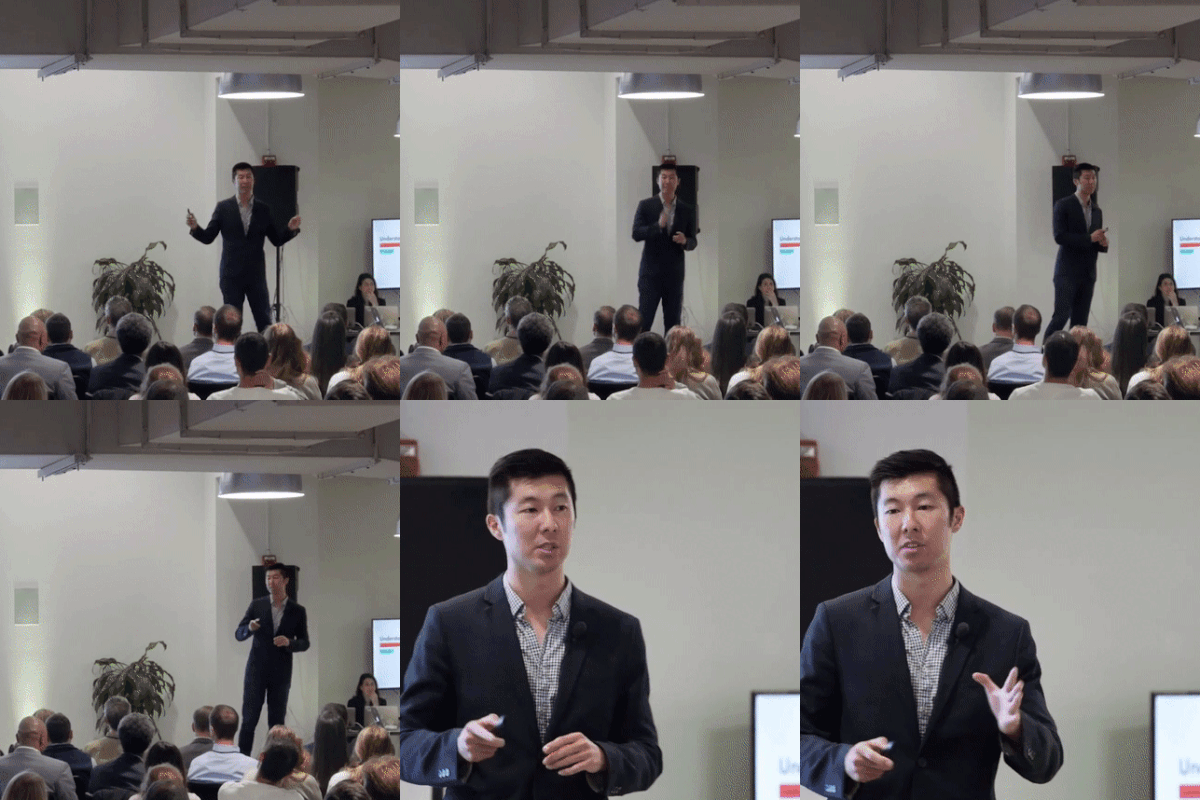
Dan Wu, JD/PhD Lead Innovation Advisor
I build and advise mission-driven ventures to scale like startups.
SVP of Product & Chief Strategy Officer.
As a go-to-market-focused product leader, I’ve led and launched products and teams at tech startups in highly-regulated domains, ranging from 6 to 8 figures in revenue.
Led core products and product marketing key to pre-seed to D raises across highly-regulated industries such as data/AI governance, real estate, & fintech; rebuilt buyer journeys to triple conversion rates; Won Toyota’s national startup competition.
Harvard JD/PhD focused on responsible innovation for basic needs.
Focus on cross-sector social capital formation, with a strong background in mixed-methods research.
Dan Wu is our Lead Innovation Advisor focused on helping leaders build safe, high-growth products. As an SVP of Product & Chief Strategy Officer, he has led and managed products to achieve 6 to 8 figures in revenue. His work is informed by his background as a Harvard JD/PhD, where he focused on responsible innovation, social networks, and mixed-methods research.

 Made with Bullet